We all start from a certain level of ignorance—whether in technology, finance, health, or career. There’s always a feeling driving us forward, a movement that might be called intelligence, curiosity, desire, thought, or emotion. This innate drive can be observed in a baby, eager to touch, see, and learn everything around them. As the baby explores, they begin to build a mental model of the world—a collection of knowledge stored in memory.
When a baby touches fire for the first time, they don’t know it’s unbearably hot and can burn. The pain of a burn instills the knowledge that fire is dangerous. Now, imagine technology so advanced that we could create a holographic fire, one that seems real but doesn’t burn. The baby wouldn’t touch it, even though it’s safe. We are all like that baby, shaped by our beliefs and experiences—often believing we can’t do something simply because of the mental models we’ve built over time.
One of my long-held beliefs is that programming, particularly software programming, is hard for me. This belief took root when I was a child growing up in a village in India. Computers were rare and expensive, not present in every household. There was a separate computer class at school, but it required an extra fee, which I didn’t pay. Computers seemed distant and inaccessible.
When I moved to Canada, I was suddenly immersed in a world where computers were integral to everything, even homework. It was strange and intimidating to type and think simultaneously—I was more comfortable with writing by hand. My fear of computers grew; I didn’t even play games on them. In my village, computers were treated with reverence. We had to take our shoes off in the computer lab, stay silent, and only the teacher could touch the machines. This created a weird relationship between me and technology.
However, I excelled in Math and Physics when I moved to Canada because I had already learned those concepts back in India. The slower pace of teaching in Canada allowed me to coast by without much effort. I chose Mechanical Engineering for college, partly because it didn’t involve much computer work and I wouldn’t have to write lengthy essays in English. It felt natural to me—a field far removed from the intimidating world of software. But someone mentioned that there was one course, C++, in the second semester. I was terrified.
In my first semester, I failed a CAD course that required computer skills. There was something in me that kept me distant from computers. In the second semester, a teaching assistant asked me to transfer a file from one folder to another—an easy task that required unzipping a file. I couldn’t do it. She remarked how surprising it was that I had made it this far in life. I failed that course, too—scoring just 8 out of 100 on the midterm and not even attempting the final. I failed the semester.
Failing a semester meant taking eight months off before retaking the same courses. During that time, I took a CAD course at a college where the pace was slower, and I had ample time to learn. There was no pressure, no exams, no grades—just learning for the sake of learning. My father even took the same course later on, well into his fifties. It was through this course that I began to get comfortable with computers and CAD software.
This experience ignited a curiosity within me, a desire to confront what I once feared. Now, the “fire” in my life is software, and I want to learn how to play with it. I’m good at my current job as a Mechanical Engineer—where I work with Excel spreadsheets and change management software, but there’s no programming involved. The job is well-defined and standardized. It’s comfortable, certain, and, frankly, boring. It lacks the excitement, the “fire” that I now crave.
Seeing others embrace the entrepreneurial spirit while I remain anchored to my comfortable profession has stirred something inside me. There’s a growing sense of unfulfillment, a realization that I need to be more self-reliant in how I make money and contribute value to the marketplace. This struggle isn’t just about my 9-to-5 job; it’s about the broader unknown that I’m starting to explore—just as I’m exploring through this very writing.
During my time in engineering school, I formed connections, but those bonds have since faded. Now, I only keep in touch with my high school friends—friends who, like me, have also chosen the path of comfort over exploration. It’s a strange feeling to see others, particularly those who embrace entrepreneurship, taking bold steps. It stirs feelings of jealousy, not because of their success, but because it highlights the direction I feel I should be moving toward.
The more I reflect on this, the clearer it becomes: to achieve something meaningful, you need to know what you want. You need to set a path and stay focused on it. Discipline and focus are key. The environment will always change, but your actions must align with your goals. Sometimes, your actions will yield results; other times, they’ll just help you maintain momentum. But your focus must remain steady. This realization has been both a challenge and a driving force as I navigate this transition.
Focus leads to discipline, discipline creates a calm mind, and a calm mind produces right actions. If you’re not calm, your energy dissipates, and you lose focus.
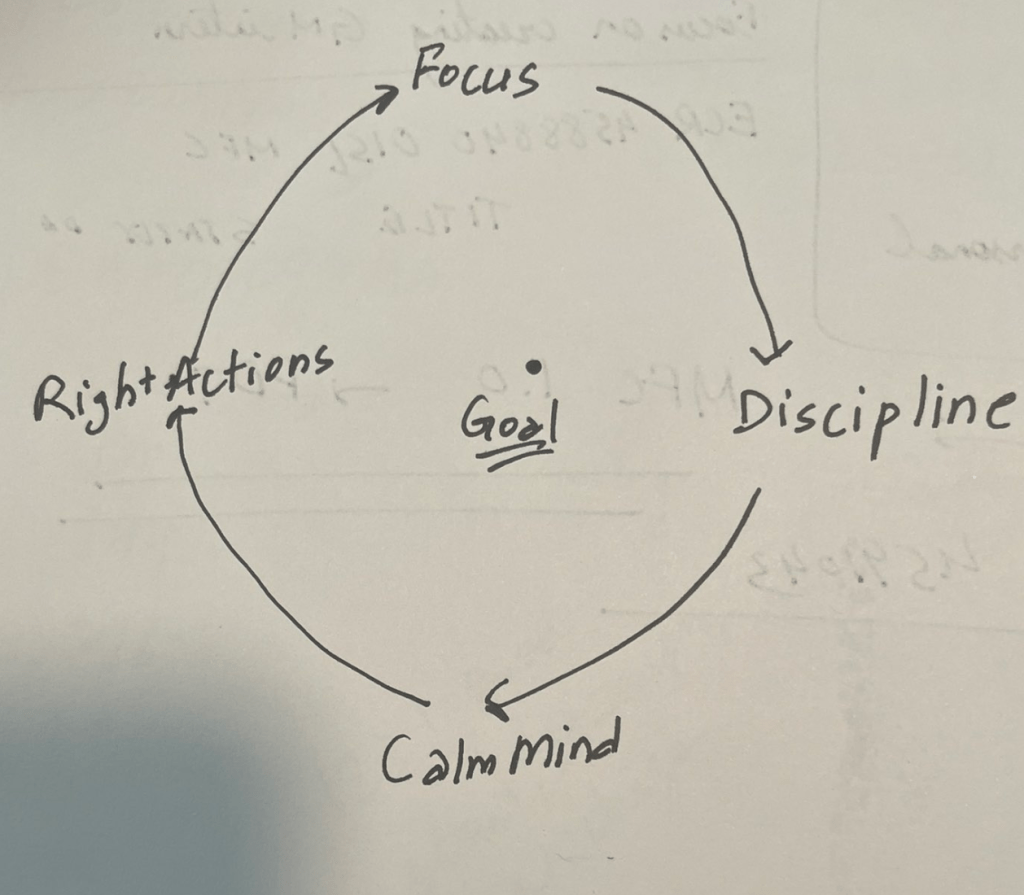
My goal is not to make fiat money—I want to get paid in Bitcoin for my work. My focus is on Bitcoin. I’m developing my focus, working from home, and documenting my Bitcoin journey on X and my blog. At 34, I feel the pressure of time—I can’t afford to switch careers leisurely. I need to make a decision now and commit to developing something meaningful in the Bitcoin space. I don’t know in what capacity yet, but I’m exploring, and that exploration itself feels like progress.
To take meaningful steps, I’ve decided to dedicate time specifically to Bitcoin—starting with one day a week, then two, then three, until it becomes a regular part of my daily routine. I’ll create tweets and content about Bitcoin education, beginning with non-technical aspects. This approach allows me to dive into Bitcoin without fear. I don’t want to be in a state of fear, as I was with computers and software. I want to enjoy the process. Fear leads to compromise, and I work best when I’m enjoying what I do. That’s why I’ll keep my current job during this transition.
There’s also the temptation to branch out, like the idea of creating YouTube videos for a Hindi-speaking audience—a market that lacks a deep understanding of Bitcoin and money. While the thought is intriguing, I recognize that it could easily become a distraction from my primary goal of building a solid foundation on X. It’s a balance I need to maintain: exploring new ideas without straying from my focus.
I’m not in a rush; I’m taking consistent action with a calm mind. My goal is not just to get a job in Bitcoin or build a business—I’m open to anything. My awareness is on Bitcoin, and I’m learning and sharing what I learn on X. Once this becomes comfortable, I’ll figure out the next step.
Stepping into the unknown brings fear, but there’s also fear in staying comfortable. I can handle this fear, find balance, and embrace it. If I ignore it, I risk turning my confusions into delusions. But as long as I keep educating myself on Bitcoin at my own pace, I feel good.
The thoughts are heavy at first, but as I write tweets, they lighten, and new ideas emerge. This clarity is what keeps me grounded and focused on my journey.
Many people have successfully transitioned into Bitcoin, each with their own unique journey. What they all share is consistency, focus, and the ability to adapt to new information. I’ve already changed my store of value from USD to Bitcoin, and now it’s time to change my source of income as well.
Fiat jobs may offer comfort, but they also breed fear—the fear of remaining unfulfilled. It’s time to seek truth in a new domain, to embrace the fire of the unknown, and to shape a future aligned with my values and aspirations.
In the end, it’s not just about the money—it’s about finding meaning in the work I do and living a life that resonates with who I truly am. Bitcoin is the path I’ve chosen, and it’s leading me toward a new kind of freedom. The journey is just beginning, and I’m ready to see where it takes me.
 Siddarth Shukla
Leave a comment