The Modern-Day Political Battle
In today’s political landscape, we’re witnessing a stark division between two ideologies. On one side, Kamala Harris represents the Democrat platform, advocating for wealth redistribution, government intervention, and social justice—values often linked to communism. On the other side, Donald Trump represents the Republicans, with their focus on capitalism, economic freedom, and personal responsibility.
But here’s the catch: Even Republicans, who advocate for free markets and personal accountability, still adhere to central banks and government control over the currency. This isn’t 100% capitalism. True capitalism would mean markets free from government manipulation, especially in the form of money printing and centralized control.
Let’s explore how this modern-day political battlefield reflects our struggle to choose between systems of thought—and how Bitcoin offers an entirely different path.

1. Democrats/Communism: Kamala Harris
Kamala Harris and the Democrats represent a political ideology that emphasizes centralized power and redistribution of wealth to achieve equality. The idea is that government control can level the playing field, making life fairer for everyone by redistributing wealth through taxes and social programs.
- Emotional Appeal: This system has a moral appeal—it feels good to support those in need. However, the downside is that such a system relies heavily on government control, which can stifle individual innovation and merit. It’s a system that assumes the government knows best, and this leads to inefficiency and economic stagnation over time.
Kamala Harris embodies this ideology of centralized control, which can resonate with people who feel disenfranchised by the current system. But the question is, does more government intervention really solve the underlying issues? Or does it create more dependency on the state?
2. Republicans/Capitalism: Donald Trump (But Not Fully Free Market)
On the other hand, Donald Trump and the Republicans stand for economic freedom, personal responsibility, and capitalism—but it’s not pure capitalism. While Republicans advocate for fewer regulations and more market-driven growth, they are still tied to central banks and a government-controlled monetary system.
- The Illusion of Free Markets: Republicans talk about free markets, but true free markets would mean that money itself is outside government control. The Federal Reserve and other central banks manipulate money supply, interest rates, and inflation—distorting markets in ways that aren’t consistent with pure capitalism.
- Trump’s Bitcoin Stance: Interestingly, Trump has shown some openness toward Bitcoin and crypto, which are steps toward true capitalism. Bitcoin offers a decentralized, scarce asset that removes government intervention from the equation. It represents the ultimate free market—money that isn’t controlled by central banks or governments.
This is where Bitcoin becomes a game-changer. While Republicans support capitalism, they are still shackled to a system where governments control the money supply. Bitcoin, by its very nature, is the first step toward real economic freedom—a system where individuals control their own wealth, free from manipulation by central banks.
3. The Struggle: Compassion vs. Responsibility
Many young people, especially those burdened by student debt or facing tough economic prospects, tend to lean toward Democrat policies, hoping for debt relief and more government support. It’s an emotionally appealing position: Who wouldn’t want to ease the burdens of life through collective action?
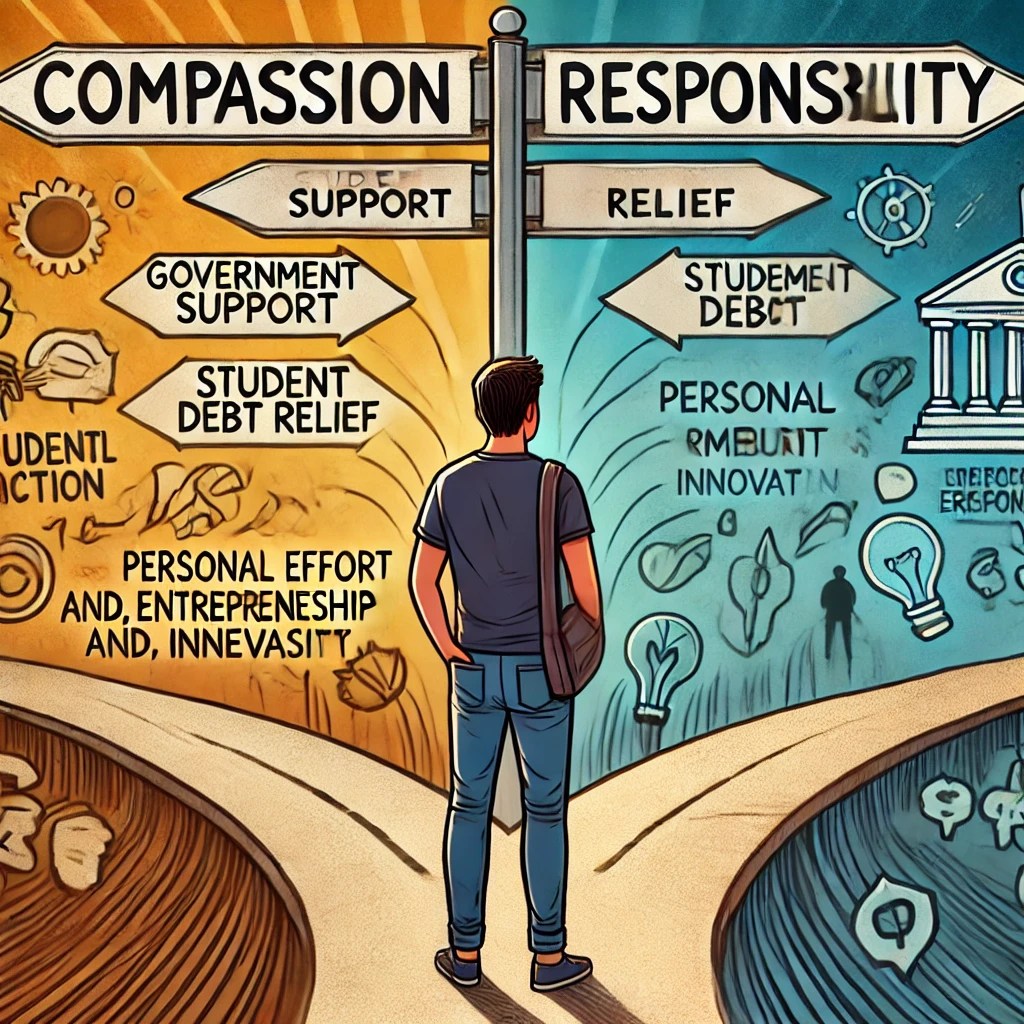
But there’s a deeper tension here: compassion versus responsibility. While it’s easy to empathize with people’s struggles, personal responsibility and merit are essential for long-term economic growth. The challenge for many young people is balancing these emotions with the harsh reality that individual effort, not government handouts, drives innovation and success.
4. Kamala Harris vs. Donald Trump: 2024 Election
As we approach the 2024 election, Kamala Harris and Donald Trump represent these two opposing ideologies. Harris embodies the push for government intervention to address systemic inequalities, while Trump, with his focus on personal accountability, advocates for market-driven solutions.
But even within Trump’s platform, there’s an acknowledgment that the current system isn’t perfect. Bitcoin represents a step toward fixing that—offering a form of money that can’t be manipulated by central banks, unlike the fiat system Republicans still support.
5. The Hidden Truth: Both Systems Rely on Fiat
Here’s the uncomfortable truth: Both Democrats and Republicans support a fiat currency system. The U.S. dollar is controlled by central banks, meaning both parties rely on money that can be inflated or devalued at any time. This undermines the true principles of capitalism.
- Democrats believe that fiat currency should be manipulated to provide more government support for social programs.
- Republicans claim to support free markets, but they’re still dependent on a monetary system that is anything but free.
This is where Bitcoin comes in as a third path. Bitcoin is a form of money that operates outside the control of any central authority. It’s scarce, decentralized, and immune to inflation—offering a real alternative to the fiat system that both political parties support in different ways.
6. Bitcoin: The True Free Market
Bitcoin offers the potential for a truly free market. It operates on a decentralized network where no government or central bank can control its supply or value. It’s capped at 21 million coins, ensuring scarcity, just like gold in the physical world. This scarcity makes Bitcoin the ultimate tool for financial freedom.
- No More Central Banks: With Bitcoin, there’s no need for central banks to manipulate interest rates or print more money. It’s a system where individuals truly control their own wealth, free from government intervention.
- True Economic Freedom: Bitcoin is the next step toward achieving true capitalism—a system where markets are driven by supply and demand, not government policies or fiat manipulation.
In a world where both Democrats and Republicans are tied to central banks, Bitcoin offers the possibility of breaking free from these constraints and achieving real economic freedom.
Conclusion: Moving Beyond Traditional Politics
The ongoing battle between Democrats and Republicans often feels like a choice between two flawed systems. Both parties rely on a fiat currency system that is manipulated by central banks, distorting the very concept of a free market.
But there’s another way: Bitcoin. It offers a decentralized, scarce, and fair system where individuals can control their own wealth. As Trump continues to show support for crypto, we are seeing the first steps toward a world where free markets are truly free—where Bitcoin can provide the financial sovereignty we’ve been searching for.
As we approach the 2024 election, it’s clear that the real path to financial freedom lies not in traditional politics, but in embracing Bitcoin and the future of decentralized, scarce money.
 Siddarth Shukla
Leave a comment